Mapping involves identifying the relationships between elements either within or across a layer of an enterprise architecture. The diagram below demonstrates the concept of mapping with respect to the Queensland Government Enterprise Architecture (QGEA).
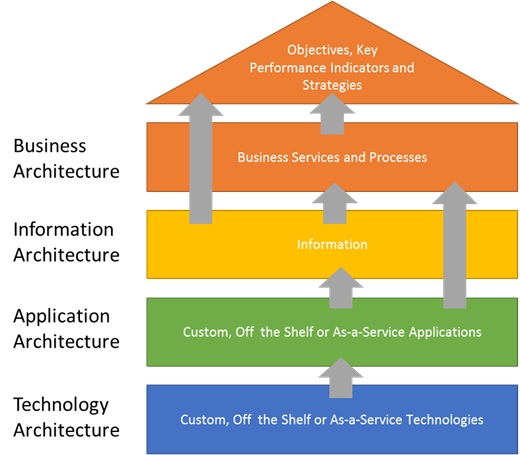
Mapping across layers is generally conducted from one layer to the layer above in an enterprise architecture. For example, business objectives can map to strategies or services to business processes or across one or more layers of an enterprise architecture such as application to information and business processes.
The extent to which mapping is conducted will depend on the scope of the planning engagement and the information available. For a large agency, it may not be feasible to map all the relationships. It may be reasonable to focus on business strategic directions and core services of the agency and map only the relationships between the business strategic direction and services, services and information as well as services and applications.
Digital and ICT planning framework mappings
The table below outlines the recommended mapping combinations for conducting digital and ICT strategic planning. It demonstrates the high concentration of mapping in the strategy and business layers. This confirms the value of mapping to understanding the business of the planning organisation in terms of its strategic direction and services.
It’s important to note there is not always a logical or valid combination between all elements. Not all possible mappings between the information gathered will yield a result which is useful for analysis.
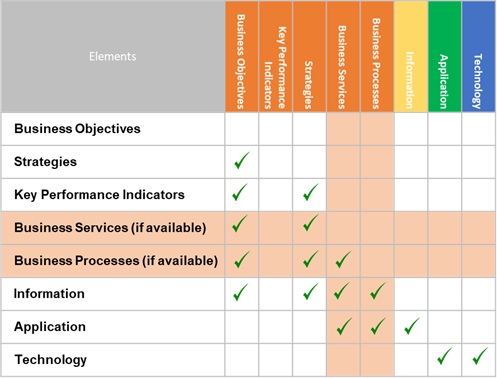
For smaller planning engagements (e.g. a single business area), conducting all recommended mappings helps ensure both the practitioner and the business has a thorough understanding of the business direction, services, processes, information, applications and technology capability of the organisation prior to commencing the planning engagement.
For larger planning engagements that cover the entire agency it may only be possible to map the relationships between the strategic elements and the relationships between information, applications and technologies.
Practitioners should review the information currently available in your organisation. As a planning or architecture team, you should agree on the mappings that represent the greatest value given the information available. Ask yourself, where there are gaps information, determine how gaps can be addressed and how the scope of mapping could be increased to provide additional value in the future?
- Last updated:
- 7 December 2022